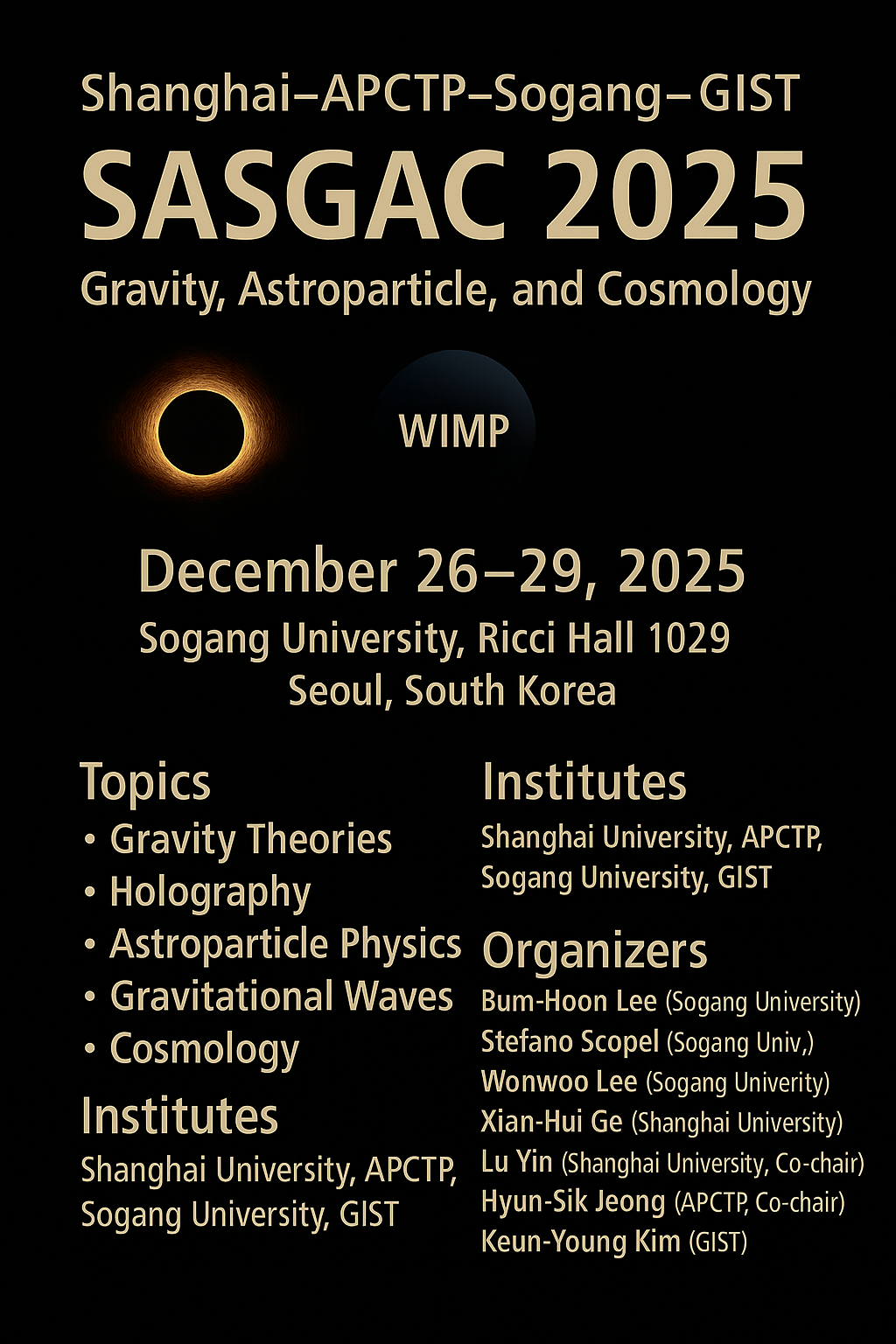
Shanghai-APCTP-Sogang-GIST workshop on Gravity, Astroparticle, and Cosmology (SASGAC 2025)

Asia/Seoul
Sogang University

Sogang University

Bum-Hoon Lee (Sogang University)
Description

Overview

This four-day "Shanghai-APCTP-Sogang-GIST workshop on Gravity, Astroparticle, and Cosmology (SASGAC 2025)" is the first research activity, conducted in institutes in China and Korea, e.g.  the Theory Center at Shanghai University, the Center for Quantum SpaceTime (CQUeST) at Sogang University, GIST, and the Asis Pacific Center for Theoretical Physics (APCTP), among others. The main topics will include gravity theories, holography, Astroparticle Physics, Gravitational Waves, and Cosmology. It is planned to initiate and enhance international collaboration, mainly among but not restricted to three institutes, in a relaxed atmosphere through the maximum discussion time, providing participants with knowledge and practical skills. The program will focus on interactions and discussions to maximise the opportunities for collaboration.


Venue

Seminar Room of Physics Department R1029 (Ricci Hall 1029), Sogang University


Organizers

Bum-Hoon Lee (Sogang U, Chair),
Lu Yin(Shanghai U, Co-chair),
Stefano Scopel(Sogang U),
Wonwoo Lee(Sogang U),
Xian-Hui Ge(Shanghai U),
Keun-Young Kim(GIST),
Hyun-Sik Jeong(APCTP, Co-chair )


The number of available presentation slots is fixed. Speaker selection will be decided at the organisers' meeting if needed.

Poster
 

Registration
Registration
Participants
  • Aaron Poole
  • Abhishek Roy
  • Adil Jueid
  • Bum-Hoon Lee
  • Chanyong Park
  • Hocheol Lee
  • Hun Jang
  • Hyeonmo Koo
  • Hyun-Sik Jeong
  • Injun Jeong
  • Jeong-Hyuck Park
  • KeDi Zhang
  • Kellie O'Neal-Ault
  • Keun-Young Kim
  • Kilar Zhang
  • Lu Yin
  • Masroor Pookkillath
  • Minjae Cho
  • Prasenjit Sanyal
  • Qianhang Ding
  • Shesansu Pal
  • Shuta Ishigaki
  • Soumya Adhikari
  • Sourav Roychowdhury
  • Stefano Scopel
  • Sunghyun Kang
  • Surojit Dalui
  • Susmita Jana
  • Wonwoo Lee
  • XianHui Ge
  • Xiaoding Zhou
  • Yi-Li Wang
  • Yu-Qi Lei
  • Yun Soo MYUNG
  • ZIYU HOU
    • 4:00 PM 4:30 PM
      Tea Party 30m

      Welcome Tea Party

    • 4:30 PM 6:00 PM
      seminar: CQUeST 1029 (Ricci Hall)

      1029

      Ricci Hall

      Sogang University

      CQUeST regular seminar

      Convener: Dr Hun Jang
      • 4:30 PM
        New physics of Early Dark Energy from the Cosmic Birefringence 50m

        Exciting clues to isotropic cosmic birefringence have recently been detected in the EB cross-power spectra of the polarization data of the cosmic microwave background (CMB). Early Dark Energy (EDE) models with a pseudoscalar field coupled to photons via a Chern-Simons term can be used to explain this phenomenon, and can also potentially be used to simultaneously resolve the H0 tension. In this work we incorporate an early dark energy scalar field, including a Chern-Simons coupling, into an existing Boltzmann solver and numerically recover the EB cross-power spectrum for two models in the literature; the α-attractor, and the Rock ‘n’ Roll field. We find that both the models fit the EB spectra, and the EB spectra alone do not possess sufficient constraining power to distinguish the two models based on current data.

        Speaker: Prof. Lu Yin
    • 9:30 AM 10:30 AM
      Morning I: Dec. 27 (Sat)

      A session about AsstroParticle Physics

      Convener: Prof. Xian-Hui Ge
      • 9:30 AM
        Black Holes as Laboratories for Dark Matter 30m

        The dark matter surrounding black hole would form dense dark environment, studying the imprint of dark matter on the observational signals from black hole via accretions and dynamical friction could be a dark matter probe. In this talk I am going to talk about how to study the nature of dark matter from radio and gravitational wave channels. With these studies, black hole would be a promising laboratory for dark matter in future observations.

        Speaker: Dr Qianhang Ding (Institute for Basic Science)
      • 10:00 AM
        Exploring the complementarity of WIMP direct detection and capture in celestial bodies using WimPyDD and WimPyC 30m

        I introduce WimPyDD and WimPyC which are object-oriented and customizable Python codes that calculate accurate predictions for the expected rates in WIMP direct detection experiments and WIMP capture rate in celestial bodies within the framework of Galilean invariant non-relativistic effective theory. Due to the experimental threshold direct detection can not explore signals at low WIMP incoming speed range, while capture in celestial bodies is favored for low or even vanishing WIMP speed. This complementarity can be analyzed using WimPyDD and WimPyC so that one can obtain bounds on WIMP-nucleus scattering which do not depend on the WIMP velocity distributions or WIMP-nucleus interactions.

        Speaker: Dr Sunghyun Kang (CQUeST)
    • 10:30 AM 11:00 AM
      Break 30m
    • 11:00 AM 12:10 PM
      Morning I: Dec. 27 (Sat)

      A session about AsstroParticle Physics

      Convener: Prof. Wonwoo Lee
      • 11:00 AM
        Thermodynamic phase structures and Quasi-normal mode of Nonlinear charged black hole 30m

        We investigate the connection between thermodynamic phase transitions and quasi-normal modes (QNMs) in charged black holes with a positive curvature constant, within the framework of F (R)-Euler-Heisenberg gravity. Nonlinear electromagnetic fields lead to rich thermodynamic phase struc-tures and significantly a!ect the QNMs of massless scalar fields. By analyzing the QNMs spectrum, we find that the transition point marking the disappearance of the divergence in the QNMs slope parameter K aligns with the change of the thermodynamic phase structure described by the heat ca-pacity, within the bounds of computational uncertainty. This precise matching holds under variations of the curvature parameter and charge. Furthermore, we show that larger angular quantum number l diminishes this correspondence, while higher overtone number n restores it beyond a threshold. These findings demonstrate that thermodynamic phase transitions of black holes carry embedded dynam-ical information, uncovering a fundamental link between black hole thermodynamic and dynamical properties.

        Speaker: Dr Yu-Qi Lei
      • 11:30 AM
        New thermodynamic phases and probes in Lyapunov exponents of EEH-AdS black holes 20m

        We illustrate the thermodynamics of the non-linear charged AdS black hole within the framework of Einstein-Euler-Heisenberg (EEH) gravity. During different thermodynamic ensembles, specifically the canonical thermodynamic ensemble with fixed charge and the grand canonical thermodynamic ensemble with fixed potential, new phases emerge. We draw the phase diagrams and probe the new phases by Lyapunov exponents.

        Speaker: Mr ZiYu Hou
      • 11:50 AM
        Gravitational Wave signals of FOPT in SO(10) 20m

        "We investigate gravitational wave signals in a non-supersymmetric grand unified model where the group SO(10) is broken in two steps to the Standard Model gauge group. We calculate the analytical form of the one-loop effective potential responsible for the first step of symmetry breaking and show that it can lead to a first-order phase transition with gravitational wave production. The present experimental sensitivity is still far from the expected signals but could be in reach of novel detector concepts

        Speaker: Mr Injun Jeong
    • 12:10 PM 12:20 PM
      Break 10m
    • 12:20 PM 12:50 PM
      Morning I: Dec. 27 (Sat)

      A session about AsstroParticle Physics

      Convener: Wonwoo Lee (CQUeST, Sogang University)
      • 12:20 PM
        Effective field theory of coupled dark energy and dark matter 30m

        We formulate an effective field theory (EFT) of coupled dark energy (DE) and dark matter (DM) interacting through energy and momentum transfers. In the DE sector, we exploit the EFT of vector-tensor theories with the presence of a preferred time direction on the cosmological background. This prescription allows one to accommodate shift-symmetric and non-shift-symmetric scalar-tensor theories by taking a particular weak coupling limit, with and without consistency conditions respectively. We deal with the DM sector as a non-relativistic perfect fluid, which can be described by a system of three scalar fields. By choosing a unitary gauge in which the perturbations in the DE and DM sectors are eaten by the metric, we incorporate the leading-order operators that characterize the energy and momentum transfers besides those present in the conventional EFT of vector-tensor and scalar-tensor theories and the non-relativistic perfect fluid. We express the second-order action of scalar perturbations in real space in terms of time- and scale-dependent dimensionless EFT parameters and derive the linear perturbation equations of motion by taking into account additional matter (baryons, radiation). In the small-scale limit, we obtain conditions for the absence of both ghosts and Laplacian instabilities and discuss how they are affected by the DE-DM interactions. We also compute the effective DM gravitational coupling Geff​ by using a quasi-static approximation for perturbations deep inside the DE sound horizon and show that the existence of momentum and energy transfers allow a possibility to realize Geff​ smaller than in the uncoupled case at low redshift.

        Speaker: Masroor Pookkillath (Center for Quantum Spacetime, Sogang University)
    • 12:50 PM 1:30 PM
      Lunch 40m
    • 1:30 PM 6:00 PM
      Free discussion 4h 30m
    • 6:00 PM 7:30 PM
      Dinner 1h 30m
    • 9:30 AM 10:30 AM
      Morning I: Gravity

      A session about AsstroParticle Physics

      Convener: Dr Yu-Qi Lei
      • 9:30 AM
        The Routhian way of Attractor mechanism 30m

        In this talk we consider static, extremal and spherically symmetric black hole solution of general Maxwell-Einstein-scalar (1+3)d theory with no scalar potential. We show that the effective one dimensional action, from which the effective black hole potential is usually computed, is the one dimensional effective Routhian of the original (1+3)d action. We further discuss this Routhian framework is equivalent to the Sen entropy functional approach, enabling one to compute the black hole entropy.

        Speaker: Dr Sourav Roychowdhury
      • 10:00 AM
        Improved PST Action for IIB Supergravity & Holography Beyond the AdS5xS5 Solutions 30m

        In ten-dimensional type IIB supergravity, the action evaluated on the AdS5 \times S5 background vanishes, whereas the five-dimensional effective action obtained via dimensional reduction on S5 yields a non-zero result consistent with the AdS/CF T correspondence. This apparent discrepancy is resolved by incorporating an appropriate boundary term into the Pasti–Sorokin–Tonin (PST) action, which restores agreement between the ten- and five-dimensional descriptions. However, this modification was originally established only for the simplified case with vanishing two-form fields on the AdS5 \times S5 solution.
        In this talk, I will revisit and generalize the problem by analyzing more intricate solutions of type IIB supergravity since it is crucial and indispensable that the holography must work for backgrounds beyond AdS_5\times S_5. We focus on three configurations: (1) Ten-dimensional spacetimes of the form AdS5 \times M5, beginning with the simplest AdS5 \times S5 and extending to deformed geometries such as the Lunin–Maldacena solution, where the internal manifold M5 is a deformed S5; (2) configurations of the form AdS4 \times M6; and (3) configurations of the form AdS6 \times M4. For each case, I will discuss the on-shell actions and demonstrate precise agreement with the corresponding lower-dimensional on-shell actions after suitable improvements are implemented."

        Speaker: Dr Soumya Adhikari
    • 10:30 AM 11:00 AM
      Break 30m
    • 11:00 AM 12:10 PM
      Morning I

      A session about AsstroParticle Physics

      • 11:00 AM
        Gravitational charges and radiation in asymptotically locally de Sitter spacetimes 30m

        This talk is motivated by the broad aim of a developing a fully nonlinear understanding of the nature of gravitational waves in asymptotically locally de Sitter (dS) spacetimes. I will begin with a review of the asymptotics of dS spacetimes, before showing (via the covariant phase space formalism) that spacetimes admitting suitable symmetries have spatially invariant charges. Relaxing the global requirement of such symmetries, I will present flux formulae which capture the effects of outgoing gravitational radiation and illustrate these via application to exact solutions, with particular emphasis on the Robinson-Trautman dS class. This talk is based on Phys.Rev.D 106 (2022) 6, L061901 and upcoming work in collaboration with Kostas Skenderis and Marika Taylor.

        Speaker: Dr Aaron Poole
      • 11:30 AM
        Equivalence of Stability Criteria for Neutron-Dark Matter Mixed Stars 40m

        We present a rigorous proof establishing the mathematical equivalence between two independent criteria for the marginal stability of multi-fluid relativistic stars: the dynamical criterion based on the vanishing of the fundamental radial pulsation mode's eigenfrequency, and the static criterion derived from the geometric alignment of mass and particle number gradients in the parameter space. Leveraging this equivalence, we introduce a powerful and computationally efficient framework as an upgraded version of the critical curve method, to systematically map the stability boundaries for multi-fluid mixed stars across the entire parameter space of central pressures. Our analysis, applied to a variety of nuclear and dark matter equations of state, reveals the existence of stable region in the observable mass-radius diagram. By resolving degeneracies with 3-dimensional Mass-Radius-Pressure diagrams, we provide a complete topological view of the ensemble. This work supplies a robust theoretical foundation for interpreting multi-messenger astronomical observations and constraining the properties of dark matter.

        Speaker: Prof. Kilar Zhang
    • 12:10 PM 12:30 PM
      Group photo 20m
    • 12:30 PM 1:30 PM
      Lunch 1h
    • 1:30 PM 2:30 PM
      Morning I

      A session about AsstroParticle Physics

      Convener: Prof. Kilar Zhang
      • 1:30 PM
        Cosmological Potential of Gravitational Wave Memory with Future Detectors 30m

        While the ΛCDM model successfully explains the late-time accelerated expansion of the universe, accumulating observational evidence suggests significant deviations from this standard cosmological framework. Determining the correct cosmological model and its parameters remains a crucial open problem in gravity and cosmology. Leveraging the enhanced sensitivity of next-generation gravitational wave (GW) detectors at high redshifts, up to z ~ 100, we propose that GW memory in a cosmological background provides a novel avenue for constraining cosmological model parameters. GWs, originating from astrophysical events, perturb the 2-D surface orthogonal to their propagation direction, generating secondary GWs and inducing a permanent distortion, or ‘memory,’ in this surface. As this memory propagates over cosmological distances, it accumulates the integrated effect of the background, encoding the cosmological signature. We demonstrate a significant amplification of this integrated cosmological memory (ICM) with distance, specifically showing an enhancement of up to a factor of 100 for sources at z ~ 10 — well within the sensitivity range of next-generation detectors like Cosmic Explorer and the Einstein Telescope. Furthermore, we investigate the implications of parity-violating dynamical Chern-Simons (dCS) gravity, showing that if the astrophysical event produces GWs with different amplitudes in the plus and cross polarization modes, this initial amplitude difference is also amplified through the ICM. Finally, we demonstrate that the distinct amplification of the ICM for the two polarization modes provides an independent constraint on the dCS parameter (α), achievable with next-generation GW detectors.

        Speaker: Dr Susmita Jana
      • 2:00 PM
        Unbounded Radius of Innermost Stable Circular Orbit in Higher-Dimensional Black Holes 30m

        In this talk, I will introduce the innermost stable circular orbit (ISCO) in higher-dimensional, static, spherically symmetric, asymptotically flat black holes with anisotropic energy-momentum tensors. Assuming the weak energy condition, a non-positive trace, and constrained radial and tangential pressures, we analyze timelike geodesics via the effective potential. We show that, unlike in four dimensions, the ISCO radius in higher dimensions admits no upper bound, and for spacetime dimensions, greater than or equal to 8, an ISCO may not exist at all.

        Speaker: Dr Hocheol Lee (Dongguk University)
    • 2:30 PM 3:00 PM
      Break 30m
    • 3:00 PM 4:00 PM
      Morning I

      A session about AsstroParticle Physics

      Convener: Prof. Hyun-Sik Jeong
      • 3:00 PM
        Prospects of heavy dark Z_D at multi-TeV muon colliders 30m

        In most Dark Matter (DM) models, the DM particles interact with each other through an unknown force carrier, the dark Z_D boson, which is associated with a broken hidden U(1)_D gauge symmetry. The DM particles can communicate to the visible sector only when Z_D develops a tiny coupling to the electromagnetic current due to a small kinetic mixing between the SM hypercharge and Z_D field strength tensors. If Z_D is the lightest particle in the hidden sector, the decay of Z_D is
        restricted only to the SM sector. In such a scenario, the production rate is governed by the mass of Z_D and the tiny kinetic mixing parameter ε. Current experiments have put strong bounds on the m_Z_D − ε space for low Z_D mass. However, the limits become weaker as the Z_D becomes heavy, and at the TeV scale, even the projected sensitivities from HL-LHC and FCC-hh deteriorate rapidly, with their reach
        limited to m_Z_D ≃ 3 TeV for ε = 0.1.

        In this talk, I will discuss the sensitivity reach of multi-TeV muon colliders for a heavy Z_D through the annihilation channel µ+µ− → Z_Dγ. I will demonstrate that muon colliders operating at 3, 6, and 10 TeV with integrated luminosities of 1, 4, and 10 ab−1, respectively, can significantly improve
        sensitivity to the kinetic mixing parameter ε over a broad Z_D mass range - particularly above 1 TeV - compared to hadron colliders.

        Speaker: Dr Prasenjit Sanyal
      • 3:30 PM
        Illuminating Scalar Dark Matter Co-Scattering in EFT with Monophoton Signatures 30m

        We investigate the co-scattering mechanism for dark matter production in an EFT framework which contains new $Z_2$-odd singlets, namely two fermions $N_{1,2}$ and a real scalar $\chi$. The singlet scalar $\chi$ is the dark matter candidate. The dimension-5 operators play a vital role to set the observed DM relic density. We focus on a nearly degenerate mass spectrum for the $Z_2$ odd particles to allow for a significant contribution from the co-scattering or co-annihilation mechanisms. We present two benchmark points where either of the two mechanisms primarily set the DM relic abundance. The main constraint on the model at the LHC arises from the ATLAS mono-$\gamma$ search. We obtain the parameter space allowed by the observed relic density and the mono-$\gamma$ search after performing a scan over the key parameters, the masses $M_{N_{1,2}}, M_\chi$ and couplings $c_3^\prime, y^\prime_{11,22}$. We find the region of parameter space where the relic abundance is set primarily by the co-scattering mechanism while being allowed by the LHC search. We also determine how the model can be further probed at the HL-LHC via the mono-$\gamma$ signature.

        Speaker: Dr Abhishek Roy
    • 4:00 PM 4:30 PM
      Break 30m
    • 4:30 PM 5:30 PM
      Morning II
      • 4:30 PM
        Comments on dynamical gauge fields in holography 30m

        In holography, or the gauge/gravity correspondence, a local symmetry in the bulk usually translates into a global symmetry on the boundary. In order to introduce dynamical gauge fields in boundary field theory, the method of double-trace deformations has been utilized in various studies. However, this approach may always involve problems of unitarity violation. In this talk, we will review and revisit issues arising when considering double-trace deformation with gauge fields.

        Speaker: Dr Shuta Ishigaki
    • 5:30 PM 8:30 PM
      Banquet 3h
    • 9:30 AM 10:10 AM
      Morning II
      Convener: Prof. Lu Yin
      • 9:30 AM
        Schwarzian soft modes, Quantum Tsallis statistics and strange metal 40m

        We develop a unified framework connecting quantum Tsallis statistics to electronic transport in strongly interacting systems. Starting from Rényi and Tsallis entropies, we construct a quantum Tsallis distribution that reduces to the conventional Fermi--Dirac distribution when q=1. For q slightly deviating from unity, the correction term in the occupation function can be mapped to a q-deformed Schwarzian action, corresponding to soft reparametrization modes. Coupling these soft modes to electrons via the Fermi Golden Rule yields a modified scattering rate, which reproduces conventional Fermi-liquid behavior at low temperatures and linear-in-temperature resistivity at high temperatures. Using the memory matrix formalism, we analyze magnetotransport, finding a linear-in-field magnetoresistance and a Hall angle consistent with Anderson's two-lifetime scenario.

        Speaker: Prof. Xian-Hui Ge
    • 10:10 AM 10:30 AM
      Break 20m
    • 10:30 AM 11:10 AM
      Morning II
      • 10:30 AM
        Next Einstein Equations: Doubled Spacetime 40m

        Double Field Theory (DFT) has emerged as a comprehensive framework for gravity, presenting a testable and robust alternative to General Relativity (GR), rooted in the ) symmetry principle of string theory. These lecture notes aim to provide an accessible introduction to DFT, structured in a manner similar to traditional GR courses. Key topics include doubled-yet-gauged coordinates, Riemannian versus non-Riemannian parametrisations of fundamental fields, covariant derivatives, curvatures, and the ) -symmetric augmentation of the Einstein field equation, identified as the unified field equation for the closed string massless sector. By offering a novel perspective, DFT addresses unresolved questions in GR and enables the exploration of diverse physical phenomena, paving the way for significant future research. This talk is based on a recent review article: https://arxiv.org/abs/2505.10163.

        Speaker: Prof. Jeong-Hyuck Park
    • 11:10 AM 11:30 AM
      Break 20m
    • 11:30 AM 12:10 PM
      Morning II
      • 11:30 AM
        Reconstructing the dual gravity from entanglement entropy 40m

        In this work, we study how to reconstruct the dual gravity theory from the QFT data, especially entanglement entropy, by applying the rule-based method (holography).

        We first attempt to derive a 3-dimensional black hole geometry from the entanglement entropy of a 2-dimensional thermal system composed of two distinct types of matter. Using the reconstructed black hole geometry, we determine various thermodynamic properties of the thermal system. We further investigate how to reconstruct the dual gravity theory of a given entanglement entropy when a relevant operator deforms a UV CFT. After finding the dual deformed geometry, we reconstruct the dual gravity theory, which allows such a deformed geometry.

        Speaker: Prof. Chanyong Park
    • 12:10 PM 12:30 PM
      Group photo 20m
    • 12:30 PM 1:30 PM
      Lunch 1h
    • 1:30 PM 3:00 PM
      Morning II
      Convener: Prof. Jeong-Hyuck Park
      • 1:30 PM
        Geometric realization of the concept of 'charge without charge' 40m
        Speaker: Prof. Wonwoo Lee
      • 2:10 PM
        Break 20m
      • 2:30 PM
        Imprints of Chaos in Gravitational Waves in EMRIs with Dehnen-type Dark Matter Halos 30m

        We investigate the signature of chaos in gravitational waves from an extreme-mass-ratio inspiral configuration, where a stellar massive object, confined in a harmonic potential, orbits a supermassive Schwarzschild-like black hole embedded in a Dehnen-type dark matter halo. First, we demonstrated the system's transition from non-chaotic to chaotic dynamics by analysing Poincaré sections, orbital evolution, and Lyapunov exponents across different energies and dark matter halo parameters. After that, we compute the gravitational waveforms of the small celestial object along different chaotic and non-chaotic orbits by implementing the numerical kludge scheme. We further perform a spectral analysis of the gravitational waveforms from such orbits. In particular, we show that when the system is in a chaotic state, the gravitational wave signals are characterized by broader frequency spectra with finite widths, enhanced amplitude and energy emission rate, distinctly differentiating them from the signals generated during the system's non-chaotic state. Furthermore, we discuss the potential detectability of these orbits for upcoming observatories like LISA, TianQin, and Taiji, emphasizing the significant potential for detecting chaotic imprints in gravitational waves to substantially enhance our understanding of chaotic dynamics in black hole physics and the dark matter environments of galactic nuclei.

        Speaker: Dr Surojit Dalui
    • 3:00 PM 3:20 PM
      Break 20m
    • 3:20 PM 4:00 PM
      Morning II
      • 3:20 PM
        Scalarization of quantum Oppenheimer-Snyder black holes 40m

        We obtain quantum parameter-mass induced spontaneous scalarization of quantum Oppenheimer-Snyder (qOS)-black hole in the Einstein-Gauss-Bonnet-scalar (EGBS) theory with the unknown qOS action. It is turned out that two Davies points of heat capacity are identified with two critical onset mass and quantum parameter, showing a strong connection between thermodynamics of bald black hole and spontaneous scalarization. Furthermore, we study onset scalarization of the extremal qOS-black hole in the EGBS theory. To obtain the scalar clouds being seeds to generate two branches of scalarized extremal qOS-black holes, we consider the near-horizon geometry of the Bertotti-Bobinson (BR) spacetime. In this case, it is shown that the appearance of a large scalar cloud at the horizon is a new feature to represent tachyon cloud with negative mass. However, a scalar cloud with standard mass around the BR spacetime blows up at the horizon. Finally, we obtain scalarized extremal qOS-black holes by adopting the entropy function approach.

        Speaker: Prof. Yun Soo MYUNG
    • 4:00 PM 4:20 PM
      Break 20m
    • 4:20 PM 5:00 PM
      Morning II
      Convener: Prof. Stefano Scopel
      • 4:20 PM
        Neural Network-Based Methods for Inverse Problems in Holography 40m

        Holography (AdS/CFT) provides a powerful framework for studying the quantum nature of gravity and strongly coupled quantum systems. This talk showcases how deep neural networks can address inverse problems in holography: specifically, reconstructing bulk gravity models from boundary observables. By integrating holography with physics-informed neural networks, we show that strongly coupled systems, from QCD-like theories to condensed-matter models and entanglement-based setups, can be analyzed in a data-driven and robust way. The aim is to demonstrate how machine-learning methods enable stable, consistent reconstructions and offer new insights that complement traditional holographic approaches.

        Speaker: Prof. Hyun-Sik Jeong
    • 5:00 PM 5:20 PM
      Closing 20m